Ripley vs Ripley vs Ripley

We’re talking today about a longform essay on the Ripley film vs the Ripley recent series. The essay is authored on her newsletter Velluto by Raffaella Silvestri, a writer/journalist from Milan whom I respect. So, pardon my Italian. English version will be found later on.

In origine c’è il film del 1999. No, in origine c’è il libro di Patricia Highsmith, che non ho letto, [ma ciò non ci interessa qui, my note] perché questo discorso si basa tutto sull’immagine, le parole non ci interessano, addio Patricia.

Cara Raffaella,

È la prima volta che ti scrivo (ma parecchio che ti seguo) e devo subito dire che il tuo essay longform su Velluto  [access by subscription] mi è piaciuto molto e mi ci sono divertito. Proprio per questo voglio ribattere a due o tre cose che hai scritto e pensato. E anche ad un’altra che non hai detto. E lo faccio da qua, a casa mia, cioè sul mio blog. Quindi passo al’inglese, comme d’abitude.

We’re talking of course of The Talented Mr. Ripley and the film/video versions that came out in different epochs. Here’s a list of items I’ll be talking about:

  1. Film is full of words, dialogues, scripting, but shall we do as it were just images?
  2. Dickie Greenleaf as portrayed by Jude Law vs the other unknown
  3. The invisible elephant in the room
  4. “Marge. Bellissima. Bianchissima, biondissima”. The “most gorgeous, whitest, blondest”, was Gwyneth Paltrow. On the other hand, the newcomer, Dakota Fanning, is “avid”, “girlbossy”?
  5. Mr. Ripley –“poi a guardarlo bene è così bello”, “Ripley, quello che prima era Matt Damon, the guy who was first Matt Damon, oggi è Andrew Scott, quello che faceva il prete in Fleabag” or, the guy who did the priest in Fleabag.
  6. Il film del 1999: “è più bello più estetico e più facilone”, more aesthetic and facile.
  7. The series: “It’s all about aesthetics… È tutta estetica: un’estetica non bella, ma di atmosfera. È il vibe a fare da padrone”, vibe is all-important.

I’ll drop item #1, because we do want to talk images, here, including the very definition of beauty. Also, we want to talk about persons and not necessarily mannequins, as Raffaella points out about the series. So Jude Law it is. But first, for clarity: we’re talking about the Ripley film of 1999 (The Talented Mr. Ripley) and the series of 2024 (Ripley). I like her female gaze view on men and their beauty for her pleasure and fun. Law is beau, like a “rowing team” member. The actor impersonating Dickie in the 2024 series is completely unknown, and possibly not that beau. Of course, we can’t really compare the two, since the simple act of thinking of Law reminds us the number of films we loved and enjoyed with him. However, I do agree that the 1999 film (at the onset of the new millennium) is fully “on”, extreme, including the plot and the characters’ beauty. And that the film is more “beautiful, aesthetic and facile”. But the series is so interesting in its contriteness, it shines in austere repentance. The black and white is not bright (but high-contrast) and gives not a light full of color or hot, like the 1999 film. But precisely for that, for the repentance, it shines. Moreover, Ripley/Scott’s fixation on Caravaggio, is it just a way to show the stem of a perilous relation forming–attraction and death? Or, what about the penitence-driven up and down climbing on lots of stairs? That is an addition I enjoyed much.

1999 was a gross simplification of what we felt. Watching it now is suffocating. But 2024 is: ‘when in doubt, let’s not talk about real people, let’s talk about puppets and put them in a nice atmosphere.’

I tend to agree on this view, but Raffaella goes too strong against the series: Atmosphere and vibe, the series is all about that, true. But I don’t feel the characters as puppets, au contraire I feel Dickie much more present in 2024 than 1999, the unknown actor wins over Jude Law in colors with a full grade in acting (uncompassionate, cold, distant, false). Same (sorry) with the Marge. Here of course my own male gaze enters the arena and I find Dakota Fanning much much more beautiful and interesting, that the insipid, immobile-faced, rigid Gwyneth Paltrow. The Dakota character “avid” and “girlbossy”? No! Instead, she is offended and sad.

And then there’s Matt Damon, the ultra-beau.

“Then if you look at him carefully he’s so handsome”, “Ripley, the one who used to be Matt Damon, is now Andrew Scott, the one who played the priest in Fleabag”.

Indeed. I’m not going over the beauty, except to me, Matt is the one most ironic about himself and his beauty. Scott, he takes himself too seriously, and that may be because he’s portrayed as a chauvinist narcissist, even a bit gender-fluid. Because the sexual attraction between Dickie and Ripley is evident in the series, perhaps not so in the 1999 movie. But again Raffaella is right, the movie was crystal clear about a representation of an epoch, no space for sexual meandering.

And now, let’s introduce the missing elephant, even though he is so strongly present in her article. His name is Alain Delon. The film was Plein Soleil (Purple Noon, 1960).

During my reading of Raffaella’s post, I kept asking myself: When is she going to talk about Alain Delon? I mean, if we’re having fun contemplating human faces and bodies, let’s embrace Alain’s too. You know, in terms of male beauty he defies Matt Damon and Andrew Scott one-handedly. But also with his innate unsympathetic face. Totally. Last, his beauty is 100% non americano, which helps in this case.

Watch this comparison:

I rest my case. The question however remains: Why did Raffaella ignore Alain and his film, the very first movie from the Ripley novel? We shall not know. She doesn’t say, but she may want to give a reply here. Or not.

—postscriptum

Originally there is the 1999 film. No, originally there is the book by Patricia Highsmith, which I have not read, [that does not interest us here, my note] because this discussion is all based on images, words do not interest us, goodbye Patricia.

Well yes, it is the first time I write to you (but I have been following you for a long time) and I must immediately say that I really liked your longform essay on Velluto [newsletter–access by subscription]. Precisely for this reason I want to respond to two or three things that you wrote and thought. And also to another that you did not say (but certainly thought). And I do it from here, my home, that is, on my blog. And so I switch to English, comme d’abitude. [Some Google Translate AI helped].
Posted in annotazioni | Tagged , , | Leave a comment

Tie Me Up

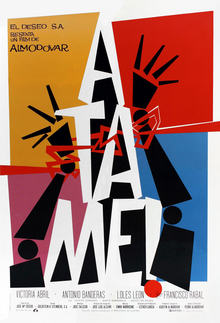
Fine exercise with cinema and some Web search, of late; and some non-coincidences. I was watching again (but after a lot since the last time) a wonderful movie from our beloved Almodóvar. Átame (Tie me up, tie me down, 1989). The plot is simple: a guy just out of a mental health institution (Antonio Banderas) believes that to reconquest his previous lover (Victoria Abril) he just needs to sequester her for a while, for he’s sure she will eventually succumb to his power of seduction and his love. She is a porn-film worker who after rebelling a bit, will fall for the man.

Apart from the universal and contemporary theme of a woman being coerced by acts of violence to submit to a man; the stereotype that if it’s real love, then it will conquest the woman’s heart eventually; the dream of romantic love that needs to be pursued; that the ends in love affairs always is worth the means; and that in the end that relationships do have that battle and equilibrium-search of force and harassment and manipulation which contrast the sweetness. All this is set as a noir-ish against a backdrop of a film director shooting a film.

Bit Almodóvar loves to dress his scenes with objects from his own collections. So, there are three moments where he shows and quotes three films:

First, there is Night of the Living Dead by J. Romero (1968) from a small b&w tv.

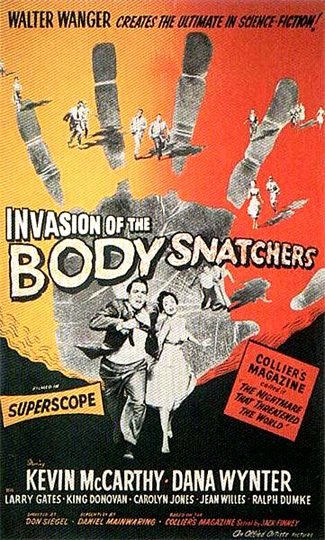
Then, Body Snatchers (1993, Abel Ferrara) on a poster within a film director’s editing office.

In truth, Don Pedro did of Time Me Up a sort-of noir, with the added twist of a film being shot within the film. There’s a lot of horror films and noirs within it. Sure enough Almodóvar got some inspiration from Peeping Tom (the guy who films everything about a woman, including the moment of her death) and The Collector (a guy who kidnaps a woman for his own desire–no coincidence, this under-plot is contained within Tie Me Up!).

IMDB quotes these connections:

Posted in annotazioni | Tagged | Leave a comment

AI bots & Higher Education

This is a post I am writing to help clarify some issues related to AI, machine learning and especially the ChatGPT algorithms that are being currently deployed. Such programming is impressive from the point of view of results: the generation of intelligible and (often) sound full text including common and not so common knowledge and multi language capacity, make of ChatGPT a wonderful and unbelievably helpful tool. At the same time this has caused a lot of rumor first regarding the capacity of being conscious, and also, in academia, for its effects on students and faculty. I will not deal here with the consciousness of such a program because it has already been established that conscious it is not.

All neural nets provoke some sort of intelligence, or better said smartness. Such programs exhibit a real-life level of smartness and knowledge about all sorts of disciplines, in all cases where they are trained accordingly and purposefully. However, as it has been written abundantly, they are nothing else that a sort of “idiot savants”, or bullshitters who speak without a clue of what they are saying. Which is extraordinarily similar to what we humans often do, and certainly students do when composing essays or other academic work. That brings me to a curious question: isn’t the case that intelligence is overrated? I mean, that the fact of being aware of one own’s utterances and their meaning, is but a narrative, something that I build bit by bit every day? But that we leave to better philosophers.

Instead, I will talk here about the impact of such family of programs in academia. I am especially worried because the emphasis has recently been one of fear. Instead of welcoming such tools for what they are, useful tools for both students and teachers and researchers alike, some in academia have been fearful that they may help students plagiarize and create texts that are not of their doing. This is once again our pushing a wildly open question into a limited and stereotyped dimension.

So we have been recently talking about how to limit the dangers that such tools create in academia. However, in academia we ought to be flipping the coin and notice that such tools may be useful and not opposites to the academic discourse. In fact, consider the case where one student together with her professor want to generate a plan for a course. That is a fascinating exercise. Together they may see whether errors were generated by the bot and review the bot’s output. Moreover, both could see where fake information may have been introduced. At the same time, the instructor could use some of the bot’s information as many have found useful. I think this very example shows that tools like these may be really very helpful for teachers and students alike. The dangers of copying or of generating homework with low quality or even plagiarized already exist with text and images and have always happened in school and universities. Of course the Internet’s encyclopedias have generated an explosion of such problems whereby faculty are not able to understand or filter works created by the mind of the students versus works not created by them. Again, if we flip the coin we see that a student can have an excellent exercise by checking facts on encyclopedias! Moreover-at least with Wikipedia- the student can suggest edits and enhancements to one article. Or create a new one—perhaps aided by ChatGPT. I’m not going to deal with grading here because grades are, in the case of a student plagiarizing, essentially another problem common to all forms of evaluation: in fact many are proposing to do without grades, at least in the evaluation of plagiarism-susceptible work. The movement called ungrading is an example of that.

But let’s go back to that theme at hand here. I just want to make sure that we are going to have a saying and that a sound and rational debate without interference from fears or irrational situations may be had widely in academia. I believe, from a moral standpoint, that censorship, policing and the forbidding of tools must not exist in academia. Hence, once again our community must find a way to understand, integrate, and operationalize such tools. Let’s not forget that this is but a preview of what it is to come and we are called–together with our students–to give the shape we want to such a future.

OpenAi’s CEO Sam Altman recently said:

I understand why educators feel this way. There are ways we can help you detect if something is ChatGPT. But I don’t think institutions should rely on that. It’s impossible to make it perfect: people will know how much text to change [to avoid a detector]. We are in a new world. Generated text is something to live with. We will all have to adapt. And it’s OK. We have adapted to calculators. This is a more extreme version but the benefits will also be more extreme. We hear from teachers who are understandably very nervous about the impact of this on homework. Though others see it as an amazing personal tutor for each student. I have used it to learn things. There are things I’d rather learn with ChatGPT than from a textbook. We will adapt, we will be better and we will not want to go back. [Translated first into Spanish by El País, and translated into English by Google Translate.]

Finally, I have compiled a list of popular press references that surely help to understand this phenomenon (in EN & ES).

Vídeo | ChatGPT: La inteligencia artificial que inventa cuentos e imágenes imposibles (El País)

Lo bueno y lo preocupante de ChatGPT, la herramienta de inteligencia artificial accesible a todos (ENDI)

ChatGPT: la inteligencia artificial que no reemplazará a los humanos (El País)

ChatGPT: no todo lo que rima es verdadero (El País)

What are We Doing About AI Essays? (Faculty Focus)

Teaching Experts Are Worried About ChatGPT, but Not for the Reasons You Think (Chronicle – paywall, but open with Sagrado email)

Teaching: Will ChatGPT Change the Way You Teach? (Chronicle – paywall, but open with Sagrado email)

Why Banning ChatGPT in Class Is a Mistake (Campus Technology)

How Smart Are the Robots Getting? (NY Times)
The Turing test used to be the gold standard for proving machine intelligence. This generation of bots is racing past it.

Alarmed by A.I. Chatbots, Universities Start Revamping How They Teach (NY Times)
With the rise of the popular new chatbot ChatGPT, colleges are restructuring some courses and taking preventive measures.

A.I. Is Not Sentient. Why Do People Say It Is? (NY Times)
Robots can’t think or feel, despite what the researchers who build them want to believe.

[Featured image: “MIT Museum: Kismet the AI robot smiles at you” by Chris Devers is licensed under CC BY-NC-ND 2.0.]

Posted in education, general | Tagged , | Leave a comment

Zen of Teaching: Interview with Stephen Downes

IN November 2022 I had an opportunity to interview Stephen Downes at Online Educa Berlin, where I was participating.

He was so kind to accept the interview and we soon found ourselves in the foyer of a stylish bar on the upper floor of the hotel, where I arranged my usually low-key equipment (my phone) and set to shoot in front of a magnificent Berliner view.

Before getting to the details of the interview I have to say it is being published quite some time after, given that on my way back home I was reached by sad news and a family loss, of which I’ll write later.

So, at the almost beginning of the new year, I want to say I’m sorry to Stephen for waiting so long without notice. Anyhow, it was an interesting and candid interview—and quite pleasant.

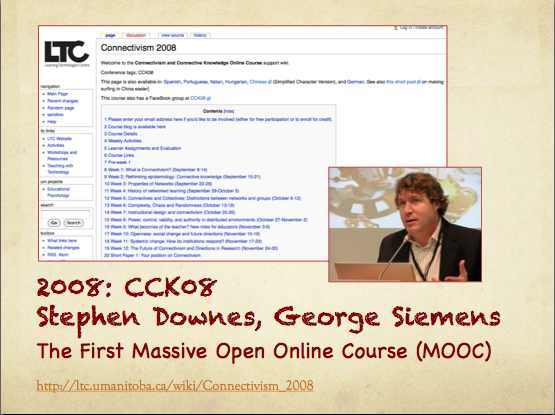
As widely known, Downes is a Canadian researcher in educational tech and pedagogy. He created with George Siemens the first MOOC (in 2008) and the very idea thereof.
(See The Rise of MOOCs Apr 23, 2012)

CCK08 First MOOC

CCK08 First MOOC

I was lucky enough to participate in said MOOC on Connectivist learning and it was an extraordinary experience which inspired me ever since in my teaching activity and tech use.

Stephen can be read at his blog Half An Hour  and his Oldaily “news and commentary about learning technology, new media, and related topic”.

So, it is in this spirit that I approached him one afternoon in Berlin, 24th November 2022. Here is the unabridged interview.

Note that there is some workers’ sound in the background: They were preparing the bar… the noise is fastidious but at that point was unavoidable and is perfectly in synch with the amateurish approach of these interviews in the #zenofteaching cycle.

We talked about AI, the metaverse vs the open Web, blockchain etc. In the case of robots vs student assistants I reckon I did not follow up with an observation: it is in interest of universities and students to have them practice as much as possible during their tenure. This would mean, in my opinion, that it would be always better to count on them as assistants than (cheaper, for sure) machines. Also, I’m not that convinced of his take on symbolic AI, but that’s on another post.

Here is the interview, then!

[Featured image: “Stephen Downes-3” by Stephen Downes is licensed under CC BY-NC 2.0.

Posted in open web, technology, zenofteaching | Tagged , , | Leave a comment

Women on fire

I’m writing this on 8 March 2022. Women’s day.
I was surprised by the response from my students, who couldn’t be more detached from this date. Some from the feminine aisle said this was to be after all a day like all. I can’t avoid being a little cynical here. When I was their age (that’s a perilous route) I was on the streets with them all.
Then listen to Because the Night and ask, why am I embedding this song here? But because it’s a matter of words. It’s what happens Under Your Command, as Patti Smith sings. Why she was under somebody’s command, I asked the adolescent myself a lot of years ago. Why? That’s the statement, it’s when I want, stupid, she replied.

Women’s day is perhaps transfixed as another Valentine, stripped of all its potency. Conferences on “Women’s role in the Fight against COVID”. No please, that’s not it. Nor is it to be “Commemorating the International Women’s Day”. Words: You don’t want to commemorate this day, as if it were dead. You want to party, sing, dance, march and ask why you still need to do it.
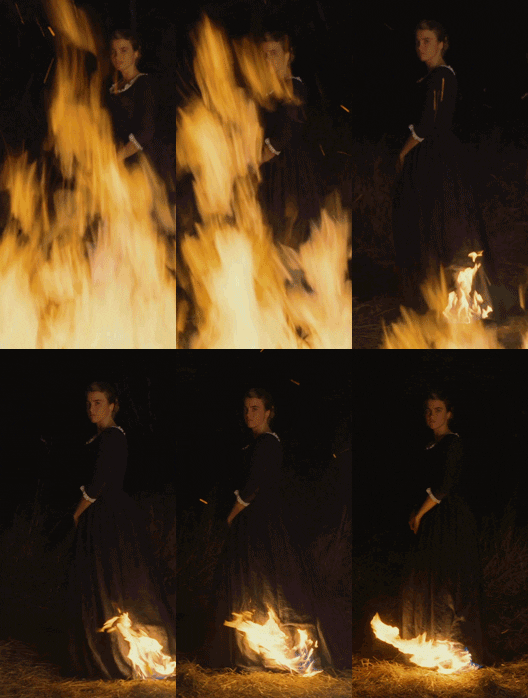
So, here is the GIF.
Women on Fire, a Gif from the Film

Women on Fire, a Gif from the Film

Then I close. Dream, and be powerful. Hope you’ll be always on fire.

Posted in open | Tagged | Leave a comment